
Advantages of Automatic Extrusion Blow Molding Machines: Maximizing Efficiency and Productivity
- What Is an Automatic Extrusion Blow Molding Machine?
- Advantages of Automatic Extrusion Blow Molding Machines
- Practices That Raise Efficiency in Automatic Extrusion Blow Molding Machines
- Applications of Automatic Extrusion Blow Molding Machines
- A Full Shine Case Study: Automated 4-Liter Oil Can Production
- FAQ
- Conclusion

Detergent bottles, milk jugs, and motor oil jugs are made by the millions. At that volume, saving a second or a cent per container adds up fast. That is why many plants are replacing manual and semi-automatic lines with an automatic extrusion blow molding machine, which produces more containers per hour at a lower cost each.
This article covers how the machine works, its advantages, ways to maximize output, and common applications.
What Is an Automatic Extrusion Blow Molding Machine?
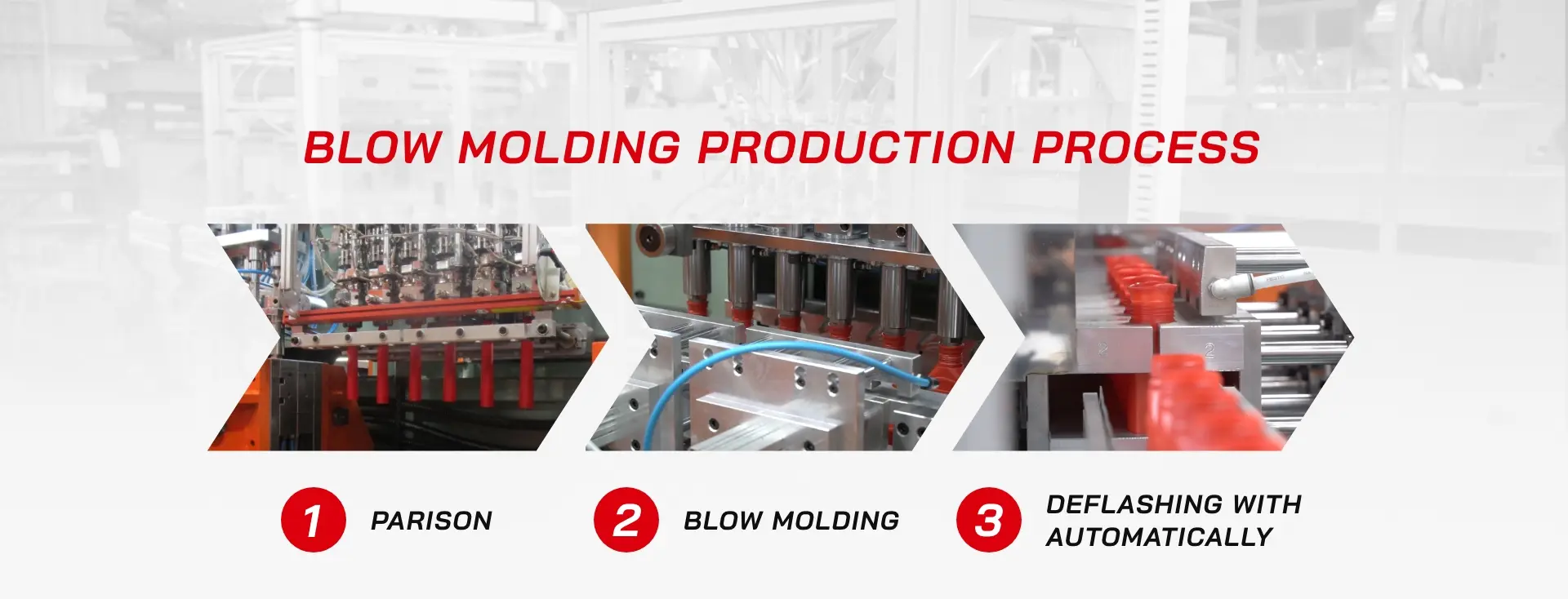
An automatic extrusion blow molding machine makes hollow plastic containers in a largely automated cycle. It melts plastic pellets and pushes the molten resin through a die to form a tube called a parison. The mold closes around the parison, and compressed air inflates it against the mold’s inner wall. The plastic then cools and hardens into shape. Manufacturers use this process to produce polypropylene (PP) and polyethylene (PE) containers, such as shampoo bottles, milk jugs, motor oil jugs, chemical drums, car fuel tanks, and toys.
These machines can be classified in three ways. By discharge method, continuous extrusion machines extrude the parison in a steady stream and suit containers up to about 30 liters. Accumulator head machines store molten resin and push it out in one shot for containers from 20 to 200 liters or more. By layout, a single-station machine has one mold station. A double-station machine molds a new parison on one side while the other side cools a finished part, which raises output without a second machine. By wall structure, a machine can extrude a single layer or co-extrude up to six layers, such as an ethylene vinyl alcohol (EVOH) layer that blocks oxygen.
Advantages of Automatic Extrusion Blow Molding Machines
Extrusion blow molding machines owe their advantages to how the parison forms and fills the mold.
Molding Complex Shapes and Integrated Handles
The mold closes around a soft parison, and compressed air pushes it into every corner of the cavity. This lets one mold form hollow handles, ribs, and offset necks as part of the container body. Asymmetric and multi-sided shapes are possible too. Polyethylene terephthalate (PET) stretch blow molding struggles to make one-piece hollow handles, so manufacturers turn to extrusion blow molding for motor oil jugs and large detergent bottles.
Working With a Wide Range of Resins
The process runs on widely available resins, including high-density polyethylene (HDPE), PP, low-density polyethylene (LDPE), and polyvinyl chloride (PVC). HDPE and PP are affordable and resist acids, alkalis, and many chemicals. Many machines can also run engineering resins such as glycol-modified PET (PETG) and polyamide (PA).
Skipping the Preform Stage
Extrusion blow molding melts and shapes resin in one continuous step. It skips the separate preform-making and reheating stages that stretch blow molding requires. This removes the need for a preform injection mold, preform storage, and a reheating oven. It also cuts the labor, shipping, and energy those stages use.
Building Multi-Layer Walls
A co-extrusion die can combine two to six layers of different resins into a single container wall. A thin EVOH layer between two HDPE layers, for example, blocks oxygen and solvents. This extends the shelf life of food, cosmetics, and pesticides. A multi-layer wall can also sandwich regrind between two layers of virgin resin, lowering material cost without exposing the regrind to the product.
Recycling Production Scrap
Extrusion blow molding machines trim flash from the neck and base of every container. That scrap is the same resin as the product, so producers can reuse nearly all of it. A grinder chops it into regrind, which goes back into the extruder mixed with virgin resin at a set ratio. Multi-layer scrap contains barrier material, so it usually goes into a dedicated regrind layer.
Producing Containers Across a Wide Size Range
Extrusion blow molding machines cover a wider size range than most molding methods. Continuous extrusion machines can produce a wide range of containers, from small pharmaceutical bottles to 30-liter jerry cans. Accumulator head machines take over for larger parts, such as 200-liter chemical drums, fuel tanks, and intermediate bulk container (IBC) tank liners.
Practices That Raise Efficiency in Automatic Extrusion Blow Molding Machines
Getting the most from an automatic line comes down to three elements: precise process control, automation, and preventive maintenance. Together they lower scrap rates and protect the return on investment.
Controlling Parison Wall Thickness
A parison controller adjusts the die gap as the parison extrudes. It thickens the wall where the parison stretches the most, such as corners and handles, and thins it elsewhere.
Recycling Scrap in Real Time
A granulator beside the machine grinds flash as it comes off the line and feeds it straight back into the hopper at a steady ratio.
Running Double-Station or Multi-Head Machines With Servo Drives
A double-station or multi-head machine forms several parisons per cycle, multiplying output. Servo drives draw power only when a part moves, cutting electricity use compared with hydraulics.
Designing Mold Cooling Channels for Even Temperature
Cooling takes up the largest share of each cycle. Channels placed close to the cavity pull heat out faster and more evenly. A mold temperature controller keeps the coolant steady, which shortens cycles and reduces warping.
Automating Post-Processing and Inspection
Automatic deflashing units trim flash, while inline stations test each finished container for leaks and check its weight. Robotic arms or conveyors move the containers between these stations. Camera inspection, increasingly backed by AI, then flags containers with thin walls, leaks, or leftover flash.
Preparing Resin and Scheduling Preventive Maintenance
Moisture-sensitive resins need drying before they enter the hopper, since moisture causes bubbles and surface defects. This applies to resins such as PETG and PA. Common resins like HDPE and PP absorb very little moisture and usually run without drying. A preventive maintenance schedule also checks wear parts, such as screws, heater bands, and seals, before they cause a breakdown.
Applications of Automatic Extrusion Blow Molding Machines
Manufacturers use automatic extrusion blow molding machines across several industries. Household and personal care brands package shampoo, detergent, and cleaning solutions in HDPE and PP bottles. Pesticides, lubricants, and chemical solvents go into jugs and drums. Some include a clear view stripe that shows the liquid level through an opaque wall. Food and beverage producers mold milk jugs and juice bottles from food-grade HDPE or PP. Medical manufacturers rely on it for bottles that hold liquid medication and saline solution. Accumulator head machines produce fuel tanks and large industrial containers. Toy and furniture makers use the process for ride-on toys and blow-molded tabletops.
A Full Shine Case Study: Automated 4-Liter Oil Can Production
The following project shows how an automatic extrusion blow molding machine helped one customer overcome three production challenges, from uneven wall thickness to limited output and material waste.
Customer Background
A plastics contract manufacturer in Pakistan needed to produce 4-liter oil cans with handles. Each can also needed a view stripe, a clear strip that shows the oil level through the can wall. Full Shine designed and built the FS-100PDDV automatic blow molding machine to meet the can design and the customer’s production needs.
Challenge 1: Maintaining Consistent Wall Thickness
Challenge: A handle can has an irregular shape. As the parison inflates, the resin may spread unevenly and leave thin walls around the handle and corners.
Solution: Full Shine customized a double die head for the can design and added a 100-point MOOG parison controller, which adjusts wall thickness at different points along the parison.
Result: The finished cans have more consistent wall thickness at the handle, corners, and body.
Challenge 2: Raising Hourly Output
Challenge: A line that forms one can at a time would limit how many cans the customer could produce each hour.
Solution: The double die head forms two parisons per cycle. The double-station layout molds new cans on one side while the other side cools.
Result: The line produces more than 480 4-liter cans per hour.
Challenge 3: Reducing Manual Handling and Material Waste
Challenge: Moving, cooling, weighing, and leak-testing each can by hand slows production and raises labor costs. Trim scrap from every cycle also adds to material costs if it is thrown away.
Solution: Robot grippers place finished cans on a conveyor that leads to a multifunctional unit, which cools, weighs, and leak-tests each can automatically. Trim scrap goes to a crusher and is loaded back into production right away.
Result: The line needs less manual handling, and production scrap is reused instead of discarded.
This scrap recycling setup reflects Full Shine’s circular economy approach and its goal of being an eco-friendly machine vendor. It helps customers run production lines that are smarter, more efficient, and less wasteful.
Further Reading: Winter 2019, Stay Focus on Full Shine Blow Molding Expert
FAQ
Q1. Why Is the Container Wall Thinner Near the Top?
This is usually parison sag. As the parison hangs from the die, its own weight stretches the upper section thin. Lowering the melt temperature or extruding faster reduces sag. A parison controller can also add thickness to that zone.
Q2. Why Does the Bottom Seam Split or Leak?
A weak pinch-off is the usual cause. If the parison is too cool when the mold closes, the two sides do not fuse well. Check the melt temperature, the mold closing speed, and the condition of the pinch-off edges in the mold.
Conclusion
Automatic extrusion blow molding machines help manufacturers improve production efficiency through automated molding, reduced manual handling, and in-line scrap recycling. Features such as parison control, multi-station configurations, and automated inspection can further improve output consistency and reduce material waste.
For manufacturers producing hollow plastic containers, choosing a machine with the right production capacity, mold configuration, and automation features is essential to meeting production requirements. Full Shine's P Series automatic blow molding machines offer single-station and double-station configurations, with 1 to 12 cavities and a production range from 20 mL to 30 L. Based in Taiwan, Full Shine is a professional manufacturer of automatic extrusion blow molding machines . Contact us to discuss a machine configuration that fits your container design and production needs.